
Next Story
Egyptian Twitter Crisis Egypt's protest to evict President Hosni Mubarak from office were successful.
On January 25 2011, over 1.5 million people of Egypt said "No!" No to poverty, no to unemployment, no to government corruption, and no autocratic governance.
On January 25 2011, over 1.5 million people of Egypt said "No!" No to poverty, no to unemployment, no to government corruption, and no autocratic governance.
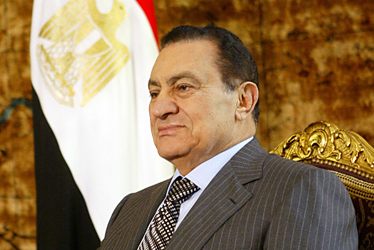 |
| President Mubarak |
Millions took the streets, a day entitled "The Day of Anger" people from, different social and economical status, and religions backgrounds, demanded President Hosni Mubarak to the left.
This chain reaction of protest started in Tunisian, when the Tunisians overthrew their long-time president.
The Egyptian people wanted "Change." President Mubarak was in control for 13 years. Protesters grieved over legal and political issues, police brutality, lack of free elections, and freedom of speech.
President Mubarak responded after the capital city Cairo was named “a war zone.” Then implement a curfew, but police or army officials didn’t enforce it. At last President Mubarak appointed Omar Suleiman former head of the Egyptian General Intelligence Directorate Omar as Vice President. Omar announced on February 11 2011, President Mubarak will no longer be president and will give power to the Supreme Council of the Armed Forces. Soon the constitution was suspended by both houses of parliament.
If you are not on the forefront of a protest, it’s not possible to dissolve the realness of the situation. We can read the media stories, watch videos, but how we do know if information has been distorted?
Park University student, Yazeed Alothman a 21 year old, sophomore pursuing a political science degree was raised in Egypt and Saudi Arabia. Currently his brother works in the Saudi Arabia Embassy in Egypt. His father retired from the Embassy in Egypt, but was present during the protest. Also his sister attends Alexandria University located in Egypt.
Yazeed studied at Kansas University for a year then transferred to Park University, he felt Kansas took advantage of international students. Now at Park University he enjoys the diverse campus, and city life of Kansas City. He still has a strong accent, but is able to communicate in English.
He began to tell me the story of Egypt from his prospective, “The people of Egypt say President Hosni Mubarak is not fair!” He then typed on the computer using an Arabic keyboard, using a converter to translate Arabic to English “Friday Anger” showed on the screen. He began typing again on the keyboard “Friday Departure” appeared. He explained on the first protest, people let the government know, we had enough. It is not right that people are in poverty in this country, jobs are scares, police are treating people wrongfully, and you have not made any changes in years. Yazeed laughing said, “After the first protest President Mubarak said he would give the people what they wanted to stop protesting, but it was to late, they wanted him out.”
Yazeed started playing the video of the protesters on Kasr al-Nil Bridge in route to Liberation Square. As I watched the video, it reminded me of the Civil Rights Movement. People where being sprayed by water cannons, tear gas halted the crowd from moving forward, At one point in the video many protesters retreated. The riot police seemed to have the situation under control. At the very movement I hought it was no possible way, the protester would get across to Liberation Square. At that very same moment there was a break in the tear gas, and the crowd began to push forward. The person recording the video started cheering, as the crowd forced the army to retreat. The success of gaining control of the bridge fueled the rest of the Egyptian people. (pic of bridge and people)
 |
| Bridge Kasr al-Nil Bridge |
Video Click Link. Protest Footage
The second protest Yazeed called “Friday Departure” “On this day the president (Mubarak) had to leave, the protesters wanted President Mubarak out immediately, Yazeed put in plain words, “My father said he was scared because the people where stealing(looting), and robbing.” I asked if he was in Egypt today would you have been in the streets protesting? He looked confused and said, “Maybe I have friends in Egypt that I went to school with when I was younger, but I was worried about my family, not really the people. My father and brother where working to get Saudi Arabia people out of Egypt.” He knew that if his family was leaving, then he more than likely would have left. He briefly spoke about his friends in Egypt, and after speaking with them, they all were ok.
I asked how he felt about the coverage of media here in the United States. He believes that America does not know the realness of what goes on in other countries. He said, “America just gets involved when money is there.” I asked him to explain more. “The US is wrong they just want money.” He stated.
Yazeed said, that he likes the system of America, and that rules are effective, but was confused by the race barrier. In detail he told a story, about going to a bar, and people stared at him and his friends, also bumping into them.
I then wonder if Yazeed plans to move back to Egypt or Saudi Arabia once graduating. He said, “Home sweet home, after graduating I will go home to Saudi Arabia, then maybe come back and get my masters degree.” What was interesting was to know the government of Saudi Arabia pays for students to
come to American and study, if your scores are high enough on test. Yazeed believes it would only be in his ethics to return to his country and use the knowledge he learned here and implement it for the enhancement of his country, although, one day he would enjoy following the footsteps of his father, and brother, and work in a Saudi Arabia Embassy, in Washington, D.C.


